
Game Overview
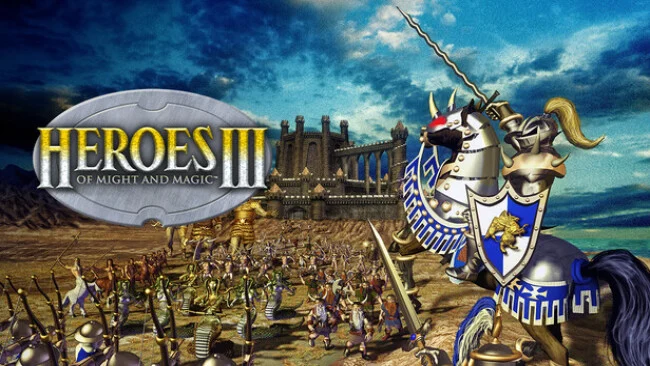
Few strategy games make a newly claimed mine, a well-timed spell, or a defended castle feel as consequential as the war for Erathia. This 1999 turn-based strategy classic combines kingdom management with tactical fantasy battles, following Queen Catherine’s effort to reclaim her homeland from invaders, traitors, and undead forces tied to her father’s fate. The included Armageddon’s Blade and The Shadow of Death expansions widen that conflict with demon armies, elemental Conflux towns, Sandro’s necromantic schemes, and several substantial story campaigns. Its tone is colorful and storybook-like, but the strategic stakes are often ruthless.
Each map asks you to recruit a hero, gather resources, build up a town, capture mines, claim artifacts, and race rival factions for territory. Heroes lead armies of creatures ranging from peasants and griffins to dragons, angels, devils, and liches; when armies meet, combat shifts to a hex-grid battlefield where positioning, unit abilities, morale, spells, and siege defenses matter. Town construction creates meaningful tradeoffs, since gold and rare resources force you to choose between stronger troops, magical upgrades, and economic growth. Campaigns teach faction strengths through scripted scenarios, while skirmish maps and the random map generator provide near-endless matches at whatever deliberate pace you prefer.
What endures is the exceptional balance between approachable rules and long-term planning. Every faction has a distinct identity, from Necropolis armies that swell through necromancy to Tower forces built around potent spellcasting, and artifact combinations can dramatically reshape a hero’s role. Its hand-painted map art, instantly readable creature designs, memorable music, and enormous map selection give it a charm that later genre entries rarely match. Fans of Civilization-style expansion, tactical RPG combat, or the strategic layer of Age of Wonders find plenty to love, while veterans still return for its deep multiplayer duels, custom scenarios, and endlessly replayable sandbox maps.
Screenshots
Installation
- Select the Download button at the top of this page to open UploadHaven.
- On UploadHaven, wait for any countdown, then select Free Download. Optional: UploadHaven Pro for faster downloads.
- When complete, extract the archive to a Heroes Of Might And Magic III folder using 7-Zip.
- Open the extracted folder and start the game normally.
- For errors, check Setup Guide & Troubleshooting below. Keep your security software enabled.
System Requirements
- Requires a 64-bit processor and operating system
- OS: Windows 11
- Processor: 1.8 GHz
- Memory: 2 GB RAM
- Graphics: 3D graphics card compatible with DirectX 9.0c
- DirectX: Version 9.0c
- Storage: 1 GB available space
Setup Guide & Troubleshooting
How do I fix missing DLL errors for Heroes Of Might And Magic III?
After extracting Heroes Of Might And Magic III, navigate to the _Redist or _CommonRedist folder inside the game directory and install DirectX, Vcredist, and any other dependencies included.
What should I do if the downloaded file is corrupted?
The full archive is 0.96 GB — make sure your download completed fully before extracting. Use 7-Zip to extract the files. If you still see a "file corrupted" error, re-download and try again.
Do I need to run the game as administrator?
Usually, no. Start the game normally from the extracted folder. If you see a permissions or save error, check that the folder is writable and follow the game's documented fix. Only grant administrator access when a trusted game's specific setup requires it.
How do I update my GPU drivers for this game?
The game won't launch — what should I try?
Check that extraction completed and your PC meets the system requirements, including Version 9.0c. Note any error message before choosing a fix. If it identifies a missing runtime, install the required DirectX components or Microsoft Visual C++ Redistributable from Microsoft.
My antivirus is blocking the game — is it safe?
A warning needs to be investigated; the download source alone cannot confirm that a file is safe. Keep your security software enabled and review the detection details. Do not run or restore a flagged file unless you have verified that it is a false positive. If you are unsure, leave it quarantined.